

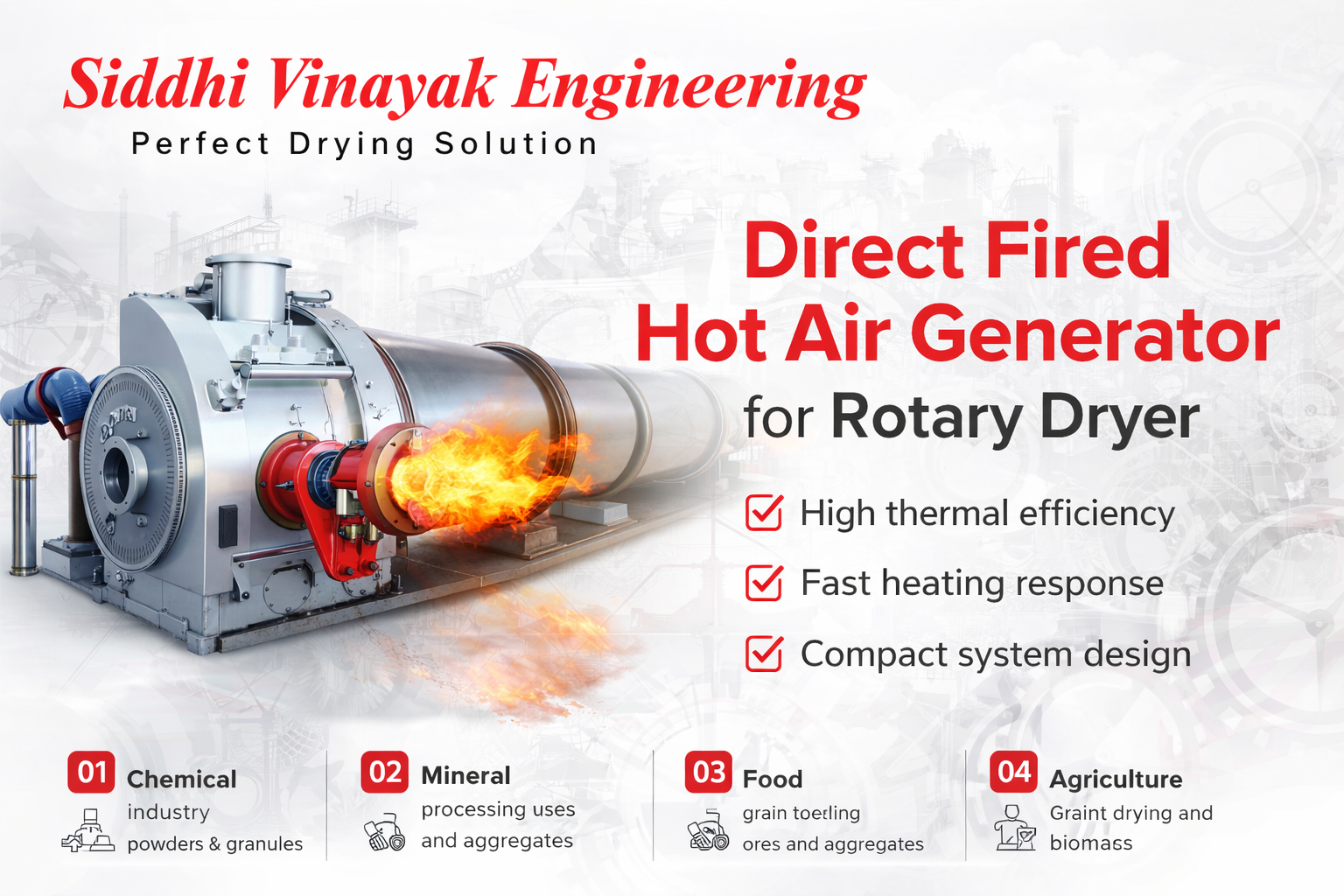
Direct Fired Hot Air Generator for Rotary Dryer
Direct Fired Hot Air Generator
for Rotary Dryer
In industrial drying processes, maintaining a consistent and efficient heat supply is essential for achieving the desired product quality and process performance. A Direct Fired Hot Air Generator for Rotary Dryer is designed to deliver high-temperature air directly into the drying system, enabling rapid and uniform moisture removal across a wide range of materials.
This heating system operates by directly mixing combustion gases with process air, resulting in efficient heat transfer. It is widely used in industries where large volumes of material need to be dried quickly, such as chemicals, minerals, food processing, and waste treatment. The system plays a critical role in improving drying efficiency while maintaining process stability.
Unlike indirect heating systems, the direct-fired approach eliminates intermediate heat exchange surfaces, reducing energy losses and improving overall thermal efficiency. This makes it a preferred solution for applications that demand high heat output and simple operation.
Key Components of a Direct Fired Hot Air Generator for Rotary Dryer
The efficiency of a Direct Fired Hot Air Generator for Rotary Dryer depends on its design and core components. Each element plays a role in maintaining stable heat generation and proper airflow.
The combustion chamber is where fuel is burned to generate high-temperature gases. The burner controls the combustion process and ensures a stable flame. A well-designed burner enhances fuel efficiency while helping to minimize emissions.
The air circulation system, including fans or blowers, directs hot air into the rotary dryer. Proper airflow distribution is essential for even heat transfer across the material bed. Temperature control units help maintain the required output by adjusting fuel input based on process needs.
Control panels and safety systems are also integrated to monitor operations, prevent overheating, and ensure safe functioning in industrial environments.
Role of Direct Fired Hot Air Generators in Rotary Dryer Systems
Rotary dryers are commonly used for drying bulk materials, and their performance depends heavily on the heating source. A Direct Fired Hot Air Generator for Rotary Dryer provides the thermal energy required for efficient drying.
The direct heating method allows heat to be transferred quickly, reducing drying time. This is especially important in high-capacity operations where continuous production is required. The system also allows flexible temperature control, making it suitable for handling different types of materials.
By supplying hot air directly into the rotary drum, the generator improves heat utilization. This results in effective moisture removal and better product consistency. It also supports scalability, making it suitable for both medium- and large-scale operations.
Advantages of Using Direct Fired Hot Air Generator for Rotary Dryer
A Direct Fired Hot Air Generator for Rotary Dryer offers several operational advantages that enhance efficiency and reliability:
- High thermal efficiency due to direct heat transfer
- Fast heating response for quick process adjustments
- Compact design that minimizes installation space
- Lower energy losses compared to indirect systems
- Suitable for continuous and high-volume drying processes
- Flexible fuel options to match different industrial requirements
These advantages make it a practical choice for industries looking to optimize drying performance while maintaining energy efficiency.
Industrial Applications of Direct Fired Hot Air Generator for Rotary Dryer
The versatility of a Direct Fired Hot Air Generator for Rotary Dryer makes it suitable for a wide range of industries. Its ability to generate high-temperature air efficiently supports various drying applications.
- 01 Chemical processing industries for drying powders and granules
- 02 Mineral processing units for drying ores and aggregates
- 03 Food processing sectors for controlled moisture removal
- 04 Textile industries for fabric drying and finishing
- 05 Waste management and sludge drying operations
- 06 Agricultural industries for drying grains and biomass
Each application benefits from consistent heat delivery, which is essential for maintaining product quality and process efficiency.
Factors to Consider Before Selecting a Direct Fired Hot Air Generator
Selecting the right Direct Fired Hot Air Generator for Rotary Dryer requires careful evaluation of process requirements. Proper selection ensures efficient and reliable performance.
Material characteristics play an important role in determining temperature and airflow needs. Factors such as moisture content, particle size, and heat sensitivity must be considered during system design.
Fuel type and availability are also key considerations. Different fuels offer varying efficiency levels and operating costs. Choosing the right fuel source supports optimal system performance.
Capacity requirements should align with production demands. An undersized system can lead to inefficient drying, while an oversized system may increase unnecessary energy consumption. Proper sizing helps achieve balanced performance.
Environmental and safety considerations must also be addressed. Emission control systems and safety mechanisms are essential for compliance with industrial standards.
Maintenance and Operational Considerations
Regular maintenance is essential to ensure the long-term performance of a Direct Fired Hot Air Generator for Rotary Dryer. Proper upkeep helps prevent unexpected downtime and maintains operational efficiency.
Routine inspection of burners, combustion chambers, and airflow systems supports smooth operation. Cleaning components helps prevent buildup that can reduce heat transfer efficiency. Monitoring temperature control systems ensures stable process conditions.
Operational monitoring is equally important. Maintaining proper fuel-air ratios and stable combustion conditions helps achieve consistent performance. Preventive maintenance schedules reduce the risk of system failures.
Future Trends in Industrial Heating for Rotary Dryers
Industrial heating systems are evolving to improve efficiency and sustainability. Modern Direct Fired Hot Air Generator for Rotary Dryer systems are being developed with advanced control technologies to enhance performance.
Automation and digital monitoring allow real-time control of temperature and airflow, improving process accuracy and reducing manual intervention. Energy-efficient designs are also being introduced to reduce fuel consumption and environmental impact.
The integration of smart technologies enables better diagnostics and predictive maintenance, ensuring reliable operation. As industries focus on sustainability, improvements in combustion efficiency and emission control are becoming increasingly important.
Frequently Asked Questions
A Direct Fired Hot Air Generator for Rotary Dryer is an industrial heating system that produces hot air by directly mixing combustion gases with air, which is then used to dry materials in a rotary dryer.
In a direct-fired system, combustion gases come into direct contact with the air being heated, whereas in an indirect-fired system, heat is transferred through a heat exchanger without mixing combustion gases with process air.
Common fuels include natural gas, diesel, propane, and other liquid or gaseous fuels depending on availability and process requirements.
It provides high-temperature air efficiently, enabling faster and more uniform drying of materials, which improves overall process performance.
It is suitable for many industrial materials, but compatibility depends on whether the material can safely come into contact with combustion gases.
The main benefits include high thermal efficiency, quick heating response, compact design, and suitability for continuous drying operations.
Efficiency can be improved through optimized burner design, proper airflow management, regular maintenance, and advanced temperature control systems.
A Direct Fired Hot Air Generator for Rotary Dryer plays a crucial role in industrial drying operations by providing efficient and consistent heat. Its direct heating mechanism enables rapid temperature generation and effective moisture removal, making it suitable for a wide range of applications.
With proper system selection, maintenance, and operational control, it can significantly improve drying performance while optimizing energy use. As industrial processes continue to advance, these systems remain essential for achieving reliable and efficient production outcomes.