

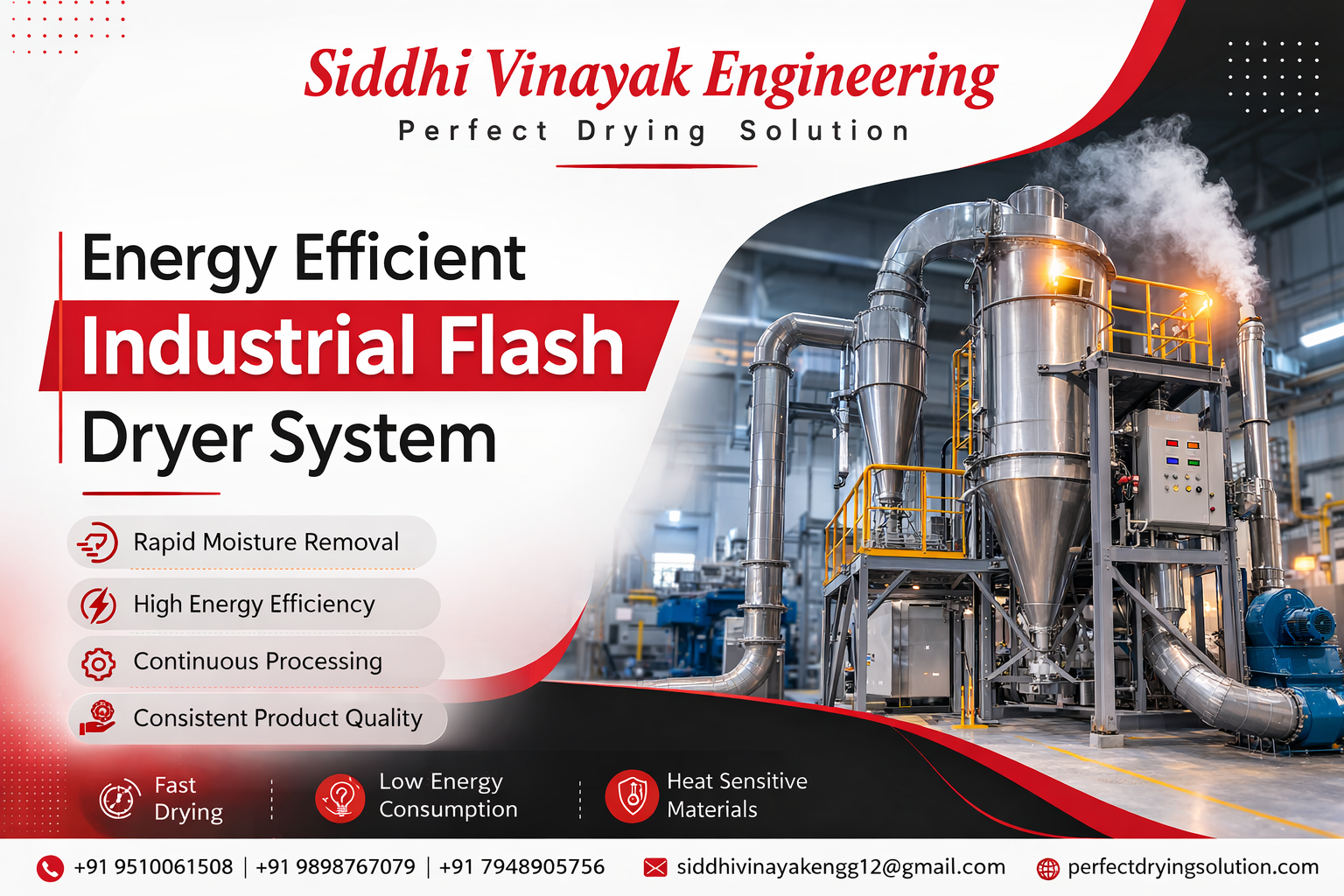
Energy Efficient Industrial Flash Dryer System
Energy Efficient Industrial Flash Dryer System
Industrial processing sectors rely on advanced drying technologies to convert wet materials into stable, dry products suitable for storage, packaging, and further processing. An energy efficient industrial flash dryer system is widely used in manufacturing environments where rapid moisture removal, controlled particle formation, and continuous processing are essential. This drying technology is designed to handle powders, granules, and slurry-based materials that require fast and efficient moisture removal while maintaining material integrity.
Flash drying technology operates on the principle of exposing wet material to high-velocity hot air for a very short duration. This brief contact allows moisture to evaporate almost instantly while preserving the physical and chemical properties of the processed material. Because the residence time of the material inside the dryer is extremely short, the system is particularly suitable for heat-sensitive materials that may degrade during longer drying processes.
Manufacturing industries increasingly rely on energy efficient industrial flash dryer systems because they offer high throughput capacity while maintaining process stability and optimized energy usage. These systems are designed to support continuous industrial production environments where consistent drying performance directly influences product quality and operational efficiency.
Understanding the Working Principle of an Energy Efficient Industrial Flash Dryer System
An energy efficient industrial flash dryer system operates by rapidly dispersing wet material into a stream of heated air inside a drying chamber. The moisture contained in the material evaporates almost instantly due to the combination of high temperature and high airflow velocity, producing dry particles that are separated through cyclones or collection systems.
The process begins with the feeding of wet material through a controlled feeding mechanism that ensures uniform dispersion into the drying chamber. Once inside the chamber, the particles interact with hot air generated by a hot air generator or heating unit.
As the particles travel through the airflow stream, moisture evaporates rapidly. The dried particles are then carried toward a separation unit where they are collected for further processing or handling. Because the exposure time is extremely short, the drying process helps preserve important physical and chemical properties of the material.
The overall efficiency of the system depends on several operational parameters such as airflow velocity, feed rate, particle size distribution, temperature control, and drying chamber design. Advanced flash dryer systems integrate these factors to achieve optimal drying performance while minimizing energy consumption.
Key Features of Energy Efficient Industrial Flash Dryer Systems
Modern industrial drying systems incorporate advanced engineering design to maintain consistent performance across a wide range of industrial applications. The energy efficient industrial flash dryer system includes several features that support efficient and reliable drying operations.
- Rapid moisture removal with extremely short residence time
- Continuous processing capability for industrial production lines
- Controlled particle size and uniform drying quality
- Efficient heat transfer through high velocity airflow
- Integration with feeding and material conveying systems
- Reduced energy consumption through optimized airflow design
- Compatibility with powder, slurry, and granular materials
These features allow industrial facilities to achieve faster drying cycles while maintaining process stability and consistent product characteristics.
Advantages of Using an Energy Efficient Industrial Flash Dryer System
Industrial manufacturers prioritize drying systems that deliver high production capacity while maintaining operational efficiency. An energy efficient industrial flash dryer system provides several operational advantages that make it suitable for demanding industrial environments.
- Faster drying rates compared with many conventional drying systems
- Lower overall energy consumption due to shorter drying cycles
- Ability to process heat-sensitive materials safely
- Continuous operation supporting high production volumes
- Reduced material handling and processing time
- Improved control over final moisture content
- Compact design compared with some other large drying equipment
These advantages contribute to improved process efficiency and greater production reliability in industrial manufacturing operations.
Industrial Applications of Flash Dryer Technology
Flash drying technology is widely used across multiple industries that require rapid moisture removal from powders and processed materials. The versatility of the energy efficient industrial flash dryer system enables it to process diverse materials with varying moisture levels and physical characteristics.
- Food processing industries use flash dryers for drying starch, protein powders, and food additives.
- Chemical manufacturing facilities apply flash drying for pigments, catalysts, and chemical intermediates.
- Pharmaceutical production processes use flash dryers for powder intermediates and formulation components.
- Mineral processing industries rely on flash drying to remove moisture from mineral powders and aggregates.
- Agricultural processing operations use flash dryers for drying organic materials and agricultural byproducts.
These applications demonstrate how flash drying systems support large-scale industrial production by providing fast, reliable, and consistent drying performance.
Factors That Influence Flash Dryer Performance
The efficiency and performance of an energy efficient industrial flash dryer system depend on several operational parameters. Industrial operators carefully manage these parameters to maintain stable drying performance and consistent product quality.
Material characteristics such as particle size, moisture content, and thermal sensitivity play a significant role in determining drying conditions. Materials with higher moisture levels may require adjustments in feed rate and airflow temperature to achieve the desired final moisture content.
Airflow velocity is another critical factor because it influences particle suspension and drying efficiency. Proper airflow ensures uniform heat transfer and helps prevent material accumulation within the drying chamber.
Temperature control is equally important for maintaining product quality. Excessively high temperatures may damage heat-sensitive materials, while insufficient heat can result in incomplete drying. Modern drying systems incorporate precise temperature control mechanisms to maintain stable operating conditions.
How Industrial Flash Dryers Improve Process Efficiency
Manufacturing industries continuously aim to improve production efficiency while maintaining consistent product quality. The energy efficient industrial flash dryer system supports this objective by combining rapid drying technology with continuous processing capability.
By minimizing the residence time of materials in the drying chamber, flash dryers reduce energy losses and improve heat utilization. This helps enhance energy efficiency compared with conventional drying processes that require longer drying periods.
Continuous processing also reduces production interruptions. Instead of batch-based drying cycles, flash dryers allow materials to be processed continuously, supporting large-scale industrial production operations.
Automation and process monitoring systems further improve operational efficiency. Sensors and control systems monitor airflow, temperature, and material flow to maintain consistent drying conditions throughout the production cycle.
Maintenance Considerations for Flash Dryer Systems
Proper maintenance plays an important role in ensuring the long-term reliability and consistent performance of industrial drying equipment. Flash dryer systems are designed for continuous operation, but regular inspection and maintenance help maintain optimal efficiency.
Routine maintenance generally includes inspection of airflow components, feeding mechanisms, drying chambers, and separation systems. Ensuring that air ducts and cyclone separators remain free from blockages helps maintain efficient airflow and consistent drying performance.
Monitoring temperature control systems and heating components is also important to prevent fluctuations in drying conditions. Regular calibration of control instruments helps ensure that process parameters remain within the required operational range.
Preventive maintenance schedules help industrial facilities reduce unexpected downtime while maintaining stable production capacity.
Future Trends in Industrial Flash Drying Technology
Industrial drying technology continues to evolve as manufacturers seek higher efficiency and improved process control. Energy efficient industrial flash dryer systems are increasingly being integrated with advanced automation technologies to enhance process monitoring and operational accuracy.
Modern systems incorporate digital control interfaces that allow operators to monitor drying parameters in real time. These systems provide improved visibility into airflow conditions, temperature levels, and material feed rates.
Energy optimization technologies are also becoming more prominent. Heat recovery systems and improved airflow designs help reduce energy consumption while maintaining drying efficiency.
As industries increasingly focus on sustainable manufacturing practices, flash drying technology is expected to continue evolving to support efficient material processing with reduced energy waste.
Conclusion
An energy efficient industrial flash dryer system plays an important role in modern industrial manufacturing where rapid moisture removal, continuous processing, and operational efficiency are essential. By utilizing high-velocity hot air and extremely short drying cycles, flash drying technology enables industries to convert wet materials into stable, dry products with consistent quality.
The flexibility of flash dryer systems allows them to process a wide variety of materials across multiple industrial sectors. As drying technology continues to advance with improved automation and energy optimization features, flash dryers remain a dependable solution for efficient industrial drying operations.