

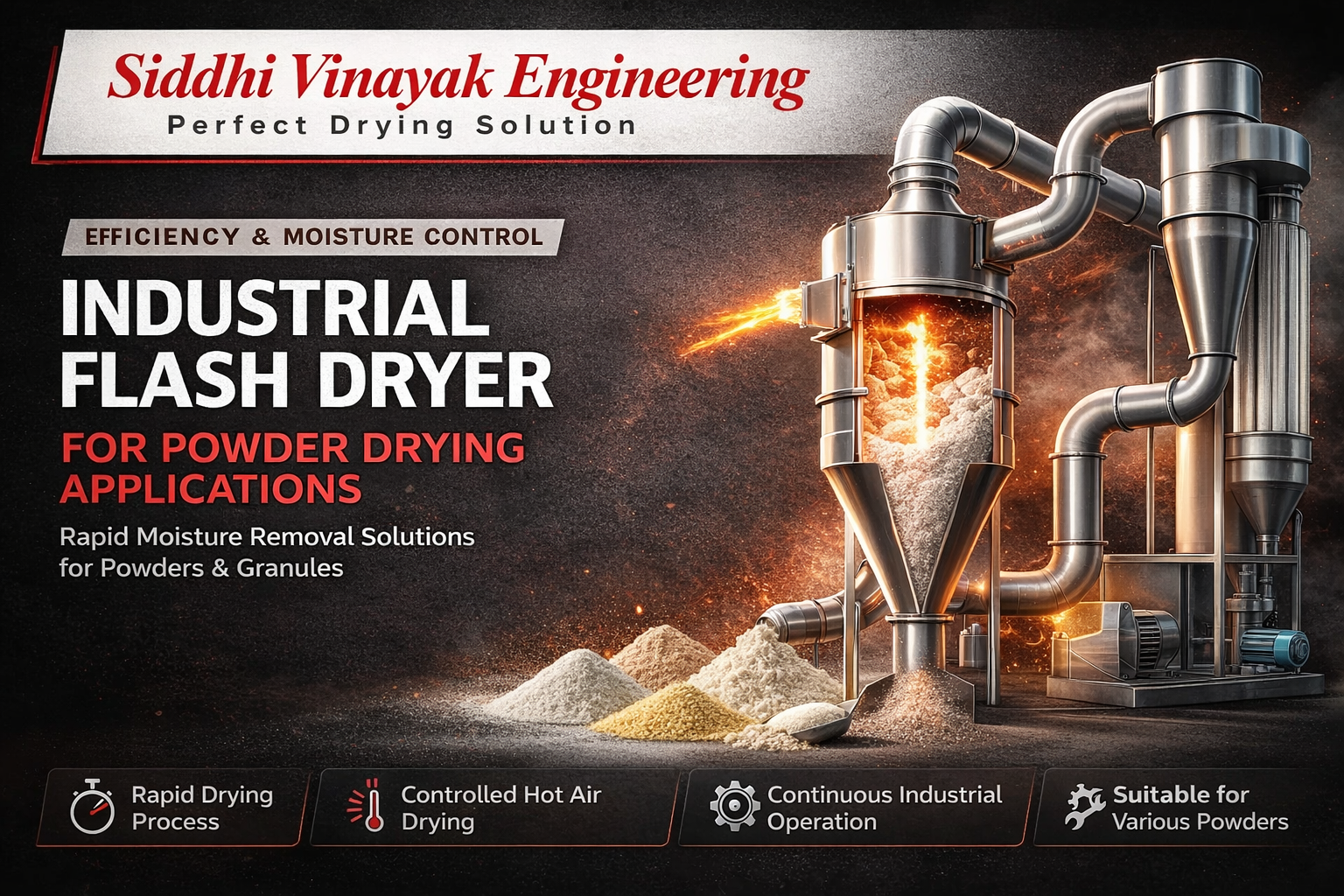
Industrial Flash Dryer for Powder Drying Applications
Industrial Flash Dryer
for Powder Drying
Applications
Industrial drying technologies are widely used across manufacturing sectors where removing moisture from materials is essential for storage, processing, and product stability. Many industries handle powders, granules, slurries, and semi-solid materials that must be dried quickly without affecting product quality. Among the various solutions available, the industrial flash dryer is recognized as one of the most effective technologies for rapid moisture removal.
An industrial flash dryer for powder drying applications is designed to quickly remove moisture from wet feed material using controlled hot air. The drying process takes place within a very short period, making this technology suitable for materials that require fast and efficient evaporation of moisture. The system enables industries to convert wet feed materials into dry powders while maintaining consistent particle characteristics.
The drying system generally consists of a feed mechanism, drying chamber, hot air generator, and separation unit. These components operate together to disperse wet material into a stream of hot air where moisture evaporates almost instantly. Due to the extremely short residence time inside the system, flash drying is known for its rapid processing capability and efficient energy utilization.
Understanding Industrial Flash Dryer Technology
An industrial flash dryer for powder drying applications operates on the principle of exposing wet material to a stream of heated air. As the material enters the drying chamber, it disperses into fine particles that come into immediate contact with the hot airflow. This direct contact causes moisture to evaporate rapidly.
The drying process occurs within seconds, making flash dryers significantly faster than many conventional drying technologies. Because the material remains inside the system for only a short time, the drying process helps maintain product characteristics while efficiently removing moisture.
A typical flash drying system includes several interconnected components that support the overall drying cycle. Wet feed material is introduced through a feeding unit, while the hot air system generates a controlled temperature airflow that carries the material through the drying chamber. As moisture evaporates, dried particles move toward the separation unit where the finished powder is collected.
Flash drying technology is commonly used for materials that disperse easily and require rapid moisture removal. The ability to combine drying and particle transport within a single process makes this technology highly efficient for continuous industrial production.
How the Flash Drying Process Works
The flash drying system follows a structured process that ensures efficient moisture removal and consistent powder production.
- Wet material is introduced into the drying chamber through a controlled feeding system.
- Heated air produced by a hot air generator enters the drying chamber at a regulated temperature.
- The wet feed disperses into fine particles when it encounters the hot airflow.
- Moisture evaporates rapidly as the particles remain suspended in the hot air stream.
- Dried particles are separated using cyclones, filters, or similar separation equipment.
- The final dry powder is collected and transferred for further processing or packaging.
Key Features of Industrial Flash Dryer for Powder Drying Applications
Industrial flash dryers are designed to deliver reliable drying performance while supporting continuous industrial operations. Their structural design and process control capabilities make them suitable for a wide range of industrial environments.
- High-speed moisture evaporation through direct contact with hot air
- Short residence time inside the drying chamber
- Continuous drying operation suitable for large-scale production
- Effective handling of powders and granular materials
- Uniform moisture removal across processed materials
- Integration with feeding and material handling systems
- Controlled airflow and temperature regulation for process stability
Advantages of Flash Drying Technology in Industrial Processing
Flash drying systems offer several advantages in industrial processes where productivity and efficiency are important. The technology is widely adopted because it combines rapid drying capability with relatively simple operation.
One of the primary advantages is the high drying speed. The short contact time between material and hot air allows moisture to evaporate quickly without exposing the material to prolonged heat.
Another important benefit is the ability to operate continuously. Flash dryers are designed for uninterrupted production cycles, enabling industries to process large volumes of material efficiently.
The system also provides improved process control. Operators can regulate parameters such as airflow, temperature, and feed rate to achieve the desired moisture level and particle characteristics.
Energy efficiency is another commonly recognized benefit. Since the drying process occurs within a short time frame, flash drying systems can reduce overall energy consumption compared to longer drying processes.
Industrial Applications of Flash Dryer for Powder Drying
An industrial flash dryer for powder drying applications is widely used in industries where materials require rapid drying and consistent powder formation.
- Food processing industry for drying starch, proteins, and food additives
- Chemical industry for drying pigments, catalysts, and chemical powders
- Pharmaceutical manufacturing for powder intermediates and ingredients
- Mineral processing for drying mineral powders and aggregates
- Agro-processing for drying agricultural by-products and raw materials
- Industrial powder production where fast moisture removal is required
Materials Commonly Processed Using Flash Dryers
Flash drying technology is particularly suitable for materials that disperse easily in hot air streams and require rapid moisture removal. These materials often include fine powders, granules, and wet solids.
In many industrial processes, materials such as chemical intermediates, pigments, food powders, and mineral particles require efficient drying before they can be packaged or used in downstream operations.
The drying system enables wet feed materials to be converted into dry powders with controlled particle properties. This improves handling, transportation, and further processing within the production chain.
The ability of flash dryers to process a wide variety of materials makes them a versatile solution for industries that rely on powder-based production processes.
Factors to Consider When Selecting an Industrial Flash Dryer
Selecting an appropriate flash dryer system requires careful evaluation of several processing factors. The efficiency of the drying system largely depends on how well it matches the characteristics of the material and the required production capacity.
Material properties play a crucial role in determining the dryer configuration. Moisture content, particle size, and thermal sensitivity influence the drying conditions needed for effective processing.
Production capacity is another important consideration. Industrial flash dryers are typically designed for continuous production environments where consistent drying output is required.
Temperature control and airflow management are also critical. Proper heat distribution ensures effective moisture removal while maintaining the quality of the dried material.
Integration with feeding systems and material handling equipment is another factor industries evaluate when implementing flash drying technology. Efficient feeding helps maintain stable drying performance and consistent powder output.
Operational Efficiency and Process Control
Industrial flash dryer systems are often designed to support automated or semi-automated process control. Sensors and monitoring systems help maintain stable temperature levels and airflow conditions during operation.
Process control plays an important role in ensuring consistent product quality. Maintaining steady operating conditions helps prevent variations in moisture content or particle distribution.
Many modern flash drying systems can be integrated with industrial control systems that monitor production parameters in real time. This allows operators to make adjustments when necessary and maintain stable drying performance.
Consistent process control also contributes to improved operational safety and equipment reliability, which are important factors in large-scale industrial environments.
Maintenance Considerations for Flash Dryer Systems
Regular maintenance is essential for maintaining the efficiency and reliability of industrial drying systems. Flash dryers typically require periodic inspection of the feeding system, hot air generator, and separation equipment to ensure proper functioning.
Cleaning and maintaining airflow components help prevent material buildup inside the drying chamber. This ensures smooth airflow and consistent drying performance.
Routine inspection of filters, cyclones, and air handling systems also helps maintain effective separation of dried particles and airflow streams. Preventive maintenance practices support the long-term stability and performance of the drying equipment.
Conclusion
Industrial flash dryer for powder drying applications plays an important role in modern industrial processing where rapid moisture removal is necessary. The technology enables industries to convert wet materials into dry powders using controlled hot air drying systems with extremely short processing times.
The efficiency of flash drying technology lies in its ability to combine rapid moisture evaporation, continuous operation, and controlled process conditions. These characteristics make the system suitable for industries that require reliable drying solutions for powders, granules, and other particulate materials.
As industrial manufacturing continues to expand across sectors such as chemicals, food processing, pharmaceuticals, and mineral processing, flash drying systems remain an important component of modern powder processing operations.
Frequently Asked Questions
An industrial flash dryer is used for rapidly drying powders, granules, and wet materials by exposing them to hot air for a very short duration. The system enables quick moisture removal while producing dry particles suitable for industrial processing.
Flash dryers remove moisture by dispersing wet material into a stream of heated air. The hot airflow causes rapid evaporation of moisture while the particles remain suspended, allowing the drying process to occur within seconds.
Flash drying systems are widely used in food processing, chemical manufacturing, pharmaceutical production, mineral processing, and agro-processing industries where efficient powder drying is required.
Flash dryers are suitable for materials that can disperse into fine particles during the drying process. These include powders, granules, chemical intermediates, pigments, mineral powders, and various industrial raw materials.
Flash drying is considered efficient because the drying process occurs in a very short time. Rapid contact between material particles and hot air allows moisture to evaporate quickly, improving drying speed and process productivity.
Yes, industrial flash dryers are typically designed for continuous operation. This enables industries to process large quantities of material without frequent interruptions, making them suitable for large-scale manufacturing environments.
Product quality is maintained by controlling airflow temperature, feed rate, and residence time within the dryer. These parameters help ensure consistent moisture removal and stable particle characteristics throughout the drying process.