

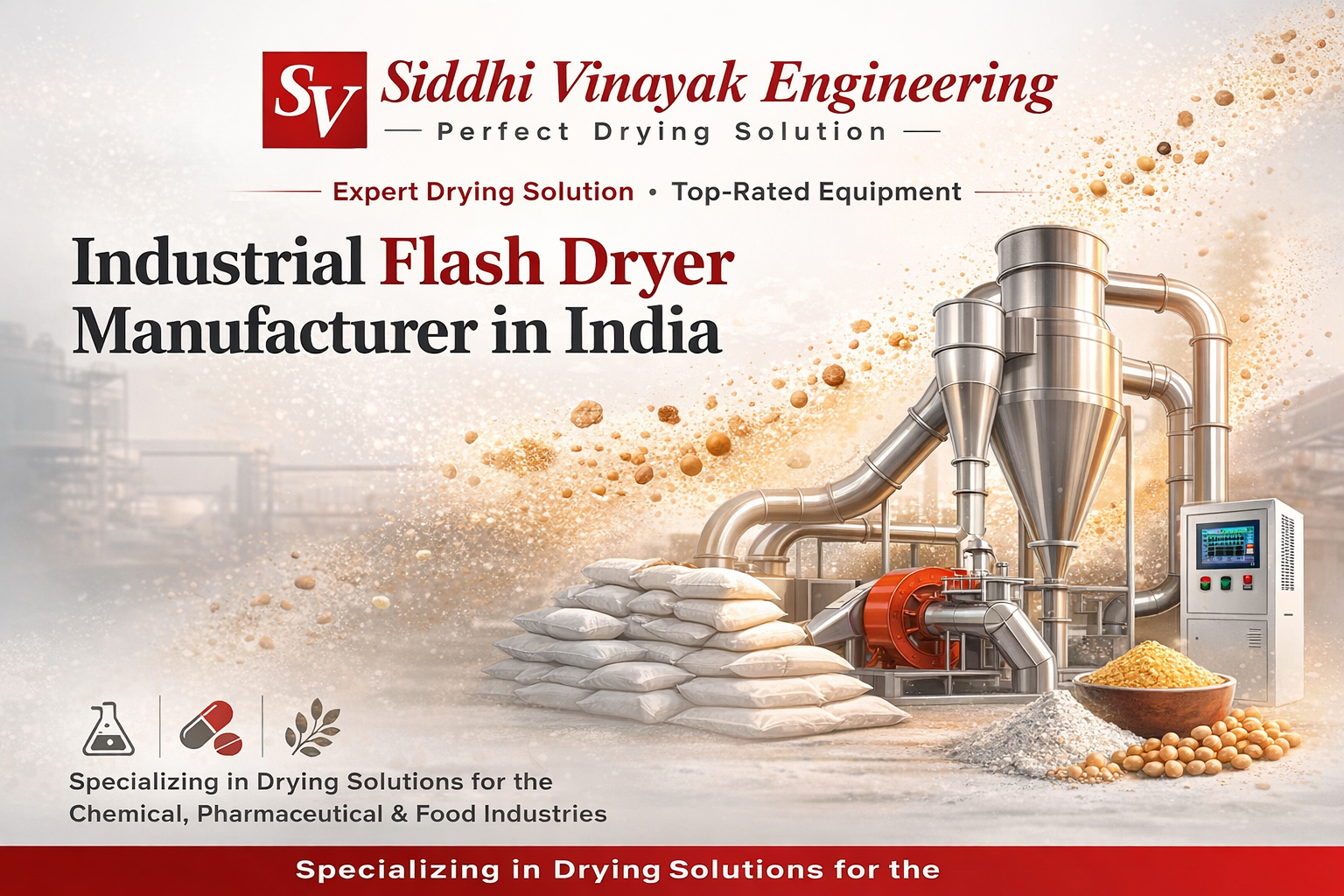
Industrial Flash Dryer Manufacturer in India
Industrial Flash Dryer
Manufacturer in India
Drying technology plays a critical role in many industrial manufacturing processes where moisture removal is necessary for product stability, handling, and storage. Various industries rely on advanced drying systems to convert wet materials into dry powders or granules efficiently. One of the most widely used technologies for rapid drying applications is the industrial flash dryer.
An industrial flash dryer manufacturer in India provides specialized drying equipment designed to remove moisture quickly from materials such as powders, granules, pastes, and filter cakes. Flash drying systems are commonly used in industries that require high production efficiency and carefully controlled drying conditions.
Flash dryers operate with extremely short residence times, allowing materials to dry rapidly while maintaining product quality. This technology is particularly suitable for heat-sensitive materials and fine powders where conventional drying systems may not provide the required speed or efficiency.
Understanding Industrial Flash Dryer Technology
An industrial flash dryer is a high-speed drying system designed to remove moisture from wet materials using hot air. The system operates by dispersing wet feed material into a high-temperature airflow inside a drying chamber. As the material comes into contact with the hot air stream, moisture evaporates almost instantly, leaving behind dried particles.
The rapid interaction between hot air and wet material allows flash dryers to achieve high drying efficiency within a very short time. This capability makes the system suitable for industrial processes where continuous drying and consistent product quality are essential.
The design of a flash dryer typically includes a feed system, drying chamber, hot air generator, cyclone separator, and product collection unit. Together, these components enable wet materials to be processed and converted into dry powders with controlled particle size and moisture levels.
Importance of Flash Dryers in Industrial Processing
In modern manufacturing industries, drying is not only about moisture removal; it also directly influences product quality, stability, and processing efficiency. Flash dryers have become an important component of industrial production systems because they provide rapid drying under controlled processing conditions.
Industries dealing with powders, chemicals, food ingredients, pharmaceutical materials, and minerals require drying equipment capable of maintaining product integrity while ensuring efficient production. Flash drying technology supports these requirements by reducing processing time and minimizing unnecessary thermal exposure.
Key Functional Features of Industrial Flash Dryers
These functional characteristics enable flash dryers to support efficient manufacturing operations while maintaining consistent drying performance.
- Rapid moisture removal due to high-velocity hot air flow
- Short material residence time that helps prevent thermal degradation
- Continuous drying operation suitable for large-scale industrial production
- Efficient handling of powders, granules, and filter cake materials
- Controlled particle size and moisture levels in the final product
- Integrated separation systems such as cyclones or bag filters
- Compact system design suitable for integration with industrial process lines
Industrial Applications of Flash Drying Systems
Flash dryers are widely used in industries where materials must be converted into dry powders or processed for further manufacturing. Their ability to handle a wide range of materials makes them suitable for multiple industrial sectors. Common industrial applications include:
- Food industry drying of starch, proteins, and food additives
- Chemical processing of pigments, catalysts, and specialty chemicals
- Pharmaceutical manufacturing of intermediates and powder formulations
- Mineral and mining industries for drying mineral powders and aggregates
- Agro-processing for drying agricultural derivatives and biomass products
- Environmental systems for drying sludge and industrial waste materials
These applications highlight the versatility of flash drying technology in handling diverse materials across different industrial processes.
How Industrial Flash Dryers Improve Production Efficiency
Industrial drying operations must balance energy consumption, processing speed, and product quality. Flash dryers significantly contribute to improving manufacturing efficiency by enabling fast and continuous drying processes.
The short drying cycle allows large quantities of material to be processed without extended processing times. This helps manufacturers maintain steady production flow while minimizing operational delays.
Another advantage is the uniform drying of particles resulting from rapid air-material interaction. This ensures consistent moisture levels in the final product, which is essential for industries where product stability and quality control are critical.
Industrial Demand for Flash Dryers in India
India has experienced significant growth in industries such as chemicals, pharmaceuticals, food processing, and mineral processing. These industries require reliable drying technologies to support large-scale manufacturing operations.
As production capacities expand, the demand for advanced drying equipment continues to grow. Industrial flash dryer manufacturers in India support these industries by providing drying systems designed for continuous processing and high operational efficiency.
Industrial zones such as chemical clusters, pharmaceutical manufacturing hubs, and food processing centers rely on drying technologies like flash dryers to maintain consistent product quality and high production output.
Factors to Consider When Selecting an Industrial Flash Dryer
Choosing the right flash dryer is an important decision for industries that depend on consistent drying performance. Several technical factors influence the efficiency and suitability of a flash drying system. Important selection considerations include:
- Type and moisture content of the feed material
- Required final moisture level in the product
- Particle size characteristics of the material
- Heat sensitivity of the product being processed
- Required production capacity and throughput
- Energy efficiency of the drying system
- Integration capability with existing production processes
Careful evaluation of these factors helps industries select drying systems that meet both operational and quality requirements.
Future Trends in Industrial Drying Technology
Industrial manufacturing continues to evolve with the introduction of advanced process technologies. Drying systems are also becoming more efficient through improvements in airflow control, heat recovery systems, and process automation.
Modern flash dryers are increasingly designed with energy-efficient components and advanced monitoring systems that allow operators to maintain precise control over drying conditions. Automation and process integration are also improving operational reliability while reducing manual intervention.
As industries place greater emphasis on sustainable manufacturing practices, drying technologies are expected to evolve further to reduce energy consumption and improve overall production efficiency.
Conclusion
Industrial flash dryers are widely used in modern manufacturing processes where rapid moisture removal and consistent product quality are required. Their ability to dry materials quickly while maintaining controlled processing conditions makes them suitable for industries such as food processing, chemicals, pharmaceuticals, and mineral processing.
With increasing industrial production demands, flash drying technology continues to play a vital role in supporting efficient and reliable manufacturing operations. By enabling rapid drying, continuous processing, and consistent product quality, industrial flash dryers remain an important part of industrial drying systems used across multiple sectors.
Frequently Asked Questions
- Rapid moisture removal due to high-velocity hot air flow
- Short material residence time that helps prevent thermal degradation
- Continuous drying operation suitable for large-scale industrial production
- Efficient handling of powders, granules, and filter cake materials
- Controlled particle size and moisture levels in the final product
- Integrated separation systems such as cyclones or bag filters
- Compact system design suitable for integration with industrial process lines
- Food industry drying of starch, proteins, and food additives
- Chemical processing of pigments, catalysts, and specialty chemicals
- Pharmaceutical manufacturing of intermediates and powder formulations
- Mineral and mining industries for drying mineral powders and aggregates
- Agro-processing for drying agricultural derivatives and biomass products
- Environmental systems for drying sludge and industrial waste materials
- Type and moisture content of the feed material
- Required final moisture level in the product
- Particle size characteristics of the material
- Heat sensitivity of the product being processed
- Required production capacity and throughput
- Energy efficiency of the drying system
- Integration capability with existing production processes