

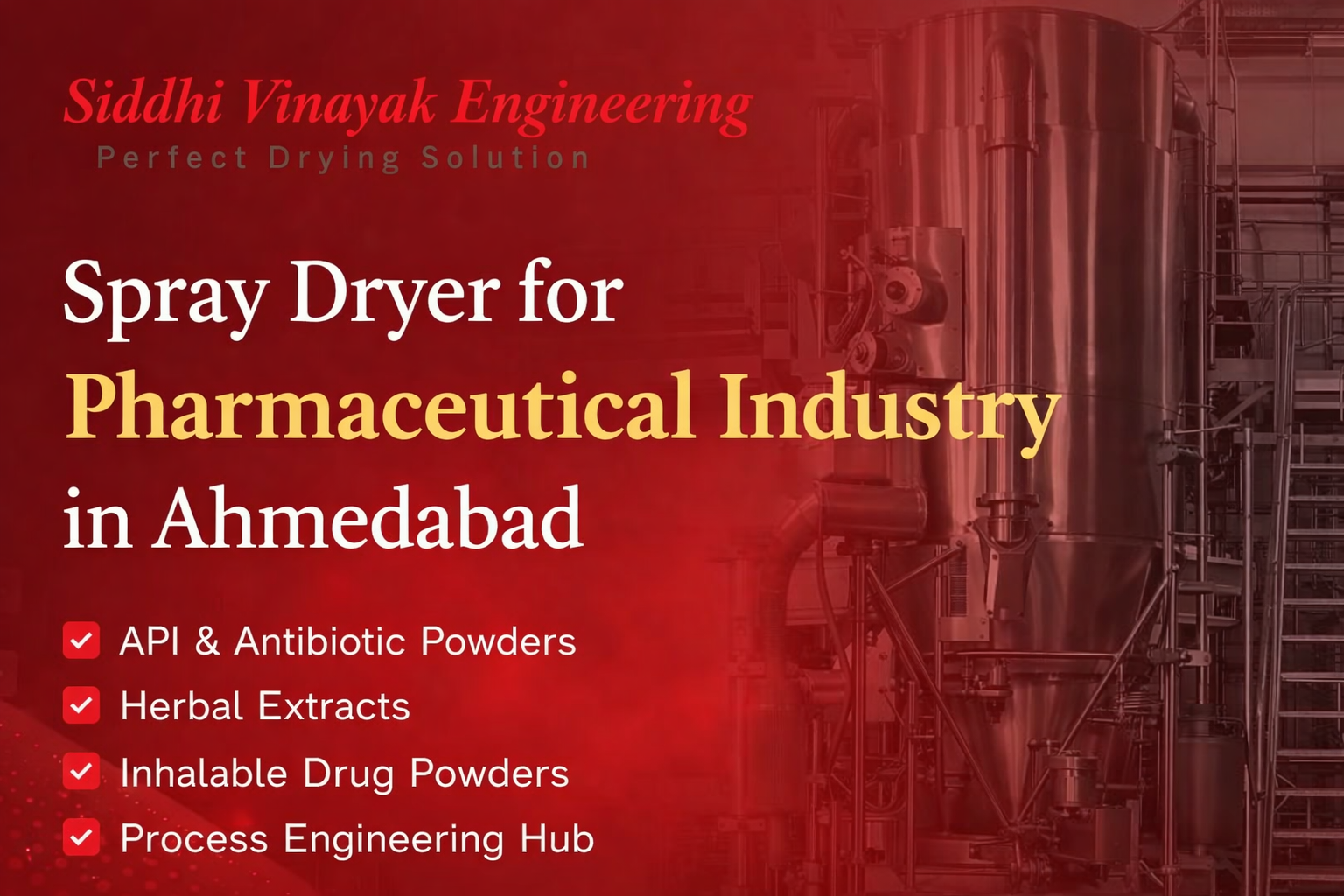
Spray Dryer for Pharmaceutical Industry in Ahmedabad
Spray Dryer for Pharmaceutical Industry in Ahmedabad
Pharmaceutical Manufacturing and Spray Drying
Pharmaceutical manufacturing demands highly controlled processing systems to maintain product stability, purity, and uniform particle characteristics. A spray dryer for pharmaceutical industry in Ahmedabad plays a vital role in converting liquid formulations into stable, free-flowing powders under carefully regulated thermal conditions. In drug production, transforming active pharmaceutical ingredients and excipients into dry powder form must comply with stringent quality and regulatory standards. Spray drying technology offers a controlled, scalable solution that aligns with these technical and compliance requirements.
Ahmedabad as a Pharmaceutical and Process Engineering Hub
Ahmedabad, particularly the Vatva GIDC industrial region, has emerged as a major hub for pharmaceutical and process engineering industries. As manufacturers increasingly prioritize consistent particle size distribution, improved solubility, and enhanced product stability, the demand for precision drying systems has grown steadily. A pharmaceutical spray dryer must deliver repeatable performance, accurate temperature control, and contamination-free processing to meet evolving regulatory expectations.
About Siddhi Vinayak Engineering
Siddhi Vinayak Engineering, located in Phase-I, GIDC Vatva, Ahmedabad, manufactures process equipment including spray dryers, flash dryers, spin flash dryers, evaporators, fluid bed dryers, hot air generators, and related systems. The company designs and supplies drying systems for the food, chemical, and pharmaceutical sectors.
Its Vatva GIDC facility supports fabrication, installation, erection, and commissioning services for industrial drying projects, ensuring structured project execution.
Understanding Spray Drying in Pharmaceutical Applications
Spray drying is a process in which a liquid feed is atomized into fine droplets and introduced into a stream of hot air inside a drying chamber. Rapid solvent evaporation results in the formation of dry powder particles. In pharmaceutical applications, this process must be precisely controlled to preserve drug stability and prevent degradation of temperature-sensitive compounds.
A pharmaceutical spray dryer typically consists of an atomization system, drying chamber, hot air generation unit, cyclone separator or bag filter, and powder collection system. Each component operates in coordination to ensure uniform drying and consistent powder output.
The process generally follows these stages:
- Preparation of the liquid feed solution or suspension
- Atomization into micro-droplets using a nozzle or rotary atomizer
- Contact with controlled hot air inside the drying chamber
- Instant solvent evaporation
- Separation and collection of dry powder particles
This controlled environment enables manufacturers to achieve defined moisture content, particle size, and bulk density characteristics essential for pharmaceutical applications.
Types of Spray Dryers Used in the Pharmaceutical Industry
Different pharmaceutical formulations require specific spray dryer configurations. Selection depends on heat sensitivity, feed viscosity, and the desired powder properties.
Concurrent Flow Spray Dryers
Concurrent flow spray dryers allow hot air and liquid feed to move in the same direction. This configuration is suitable for heat-sensitive materials, as the highest temperature exposure occurs at the initial stage when evaporation is rapid.
Counter-Current Flow Systems
Counter-current flow systems move hot air and droplets in opposite directions. These systems are used when extended drying contact is required to achieve lower residual moisture levels.
Fluidized Bed Integrated Spray Dryers
Fluidized bed integrated spray dryers combine spray drying with fluidized bed technology. This arrangement enhances final moisture reduction and improves powder uniformity.
Rotary Disc Atomizer and Nozzle-Type Spray Dryers
Rotary disc atomizer and nozzle-type spray dryers are selected based on feed characteristics and required particle distribution. Pharmaceutical processes typically require uniform droplet formation to maintain consistent particle morphology and performance.
Why Ahmedabad is a Growing Hub for Pharmaceutical Spray Dryers
Ahmedabad has a strong pharmaceutical manufacturing base supported by established infrastructure, a skilled workforce, and industrial zones such as Vatva GIDC. Many pharmaceutical companies in Gujarat require in-house powder processing capabilities for APIs, excipients, herbal extracts, and specialty formulations.
The presence of engineering manufacturers in Ahmedabad supports faster project execution, localized technical assistance, and reduced logistical complexity. Proximity to pharmaceutical units allows smoother coordination during installation, commissioning, and validation stages.
For pharmaceutical manufacturers in Gujarat and neighboring states, sourcing a spray dryer for pharmaceutical industry in Ahmedabad supports operational continuity and long-term maintenance planning.
Key Technical Considerations in Pharmaceutical Spray Drying
When selecting a spray dryer for pharmaceutical use, several parameters directly influence product quality and compliance:
- Controlled inlet and outlet air temperature management
- Precise atomization control for uniform particle size
- Hygienic design with cleanable internal surfaces
- Stainless steel construction aligned with pharmaceutical standards
- Efficient powder recovery systems to minimize material loss
- Integrated dust collection and filtration
Temperature control is particularly critical, as many pharmaceutical compounds are sensitive to thermal degradation. Accurate monitoring ensures the drying process does not compromise chemical integrity.
Material of construction must comply with pharmaceutical norms, typically involving stainless steel contact parts and smooth internal finishes to prevent contamination and residue buildup.
Applications of Spray Dryer in the Pharmaceutical Sector
Spray dryers are widely used in pharmaceutical processing for various purposes:
- Production of active pharmaceutical ingredient powders
- Drying of antibiotic and nutraceutical formulations
- Manufacturing of inhalable drug powders
- Preparation of herbal extracts and botanical powders
- Encapsulation of sensitive compounds
- Development of amorphous solid dispersions
Inhalable drug formulations, for instance, require extremely fine and uniform particle size distribution. Spray drying technology supports this level of precision, making it suitable for respiratory drug manufacturing.
Similarly, in antibiotic production, controlled moisture levels contribute to stability during storage and transportation.
Integration with Other Pharmaceutical Process Systems
A spray dryer typically operates as part of an integrated processing system. It is often connected with upstream and downstream equipment such as evaporators, fluid bed dryers, and hot air generators. In pharmaceutical plants, such integration enhances efficiency and ensures a controlled workflow.
Hot air generators provide consistent thermal energy for evaporation. Fluid bed dryers may support secondary drying or cooling stages, while evaporators can concentrate feed before spray drying.
In facilities where effluent management is critical, systems such as zero liquid discharge units or effluent spray dryers can align with primary drying operations to support responsible waste management.
Installation, Erection and Commissioning in Vatva GIDC
Pharmaceutical manufacturing projects require structured installation and commissioning procedures. Equipment alignment, airflow calibration, temperature validation, and trial production runs must be conducted carefully before full-scale operation.
Within Ahmedabad's industrial environment, commissioning support ensures that the spray dryer operates according to defined process parameters. Proper erection practices also reduce operational risks and contribute to long-term equipment reliability.
Compliance and Process Control in Pharmaceutical Spray Drying
Regulatory compliance is fundamental in pharmaceutical production. Spray dryers used in this sector must support process validation and detailed documentation. Monitoring systems typically include temperature sensors, pressure indicators, and airflow control instruments.
Controlled process parameters enable manufacturers to maintain batch-to-batch consistency. Stable operations reduce variability in particle size and moisture content, both of which directly influence drug performance and shelf life.
Automation systems can be integrated to record operational data, supporting traceability and quality assurance review.
Operational Benefits for Pharmaceutical Manufacturers
When properly configured for pharmaceutical applications, spray drying offers several operational advantages:
- Rapid and continuous drying process
- Controlled particle size distribution
- Improved powder flow properties
- Reduced processing time compared to conventional drying
- Scalable production capacity
- Enhanced solubility through particle engineering
These advantages support both research and commercial production. Pilot-scale spray dryers are commonly used during formulation development before scaling up to industrial production units.
Maintenance and Long-Term Reliability
Routine inspection of atomizers, chamber surfaces, air filters, and collection systems helps maintain consistent performance. Preventive maintenance reduces downtime and supports uninterrupted pharmaceutical production cycles.
In Ahmedabad's industrial environment, structured maintenance schedules contribute to sustained efficiency and long-term operational stability.
Frequently Asked Questions
A spray dryer converts liquid formulations into dry powders by atomizing the liquid into fine droplets and exposing them to controlled hot air. This process enables manufacturers to produce stable, uniform, and free-flowing powders suitable for further processing or packaging.
Spray drying can produce fine particles with increased surface area and, in some cases, amorphous structures. This may enhance dissolution rates and improve the solubility of poorly water-soluble drugs, supporting advanced formulation strategies.
Yes. With properly controlled temperature profiles, spray drying can process heat-sensitive compounds. Concurrent flow designs allow rapid evaporation, reducing exposure time to elevated temperatures and helping protect sensitive materials.
Pharmaceutical spray dryers are typically constructed with stainless steel contact parts to maintain hygiene standards and prevent contamination. Smooth internal finishes support effective cleaning and regulatory compliance.
Spray dryers are often integrated with evaporators, fluid bed dryers, hot air generators, and dust collection systems. Such integration ensures efficient processing, controlled moisture management, and proper powder handling within pharmaceutical facilities.