

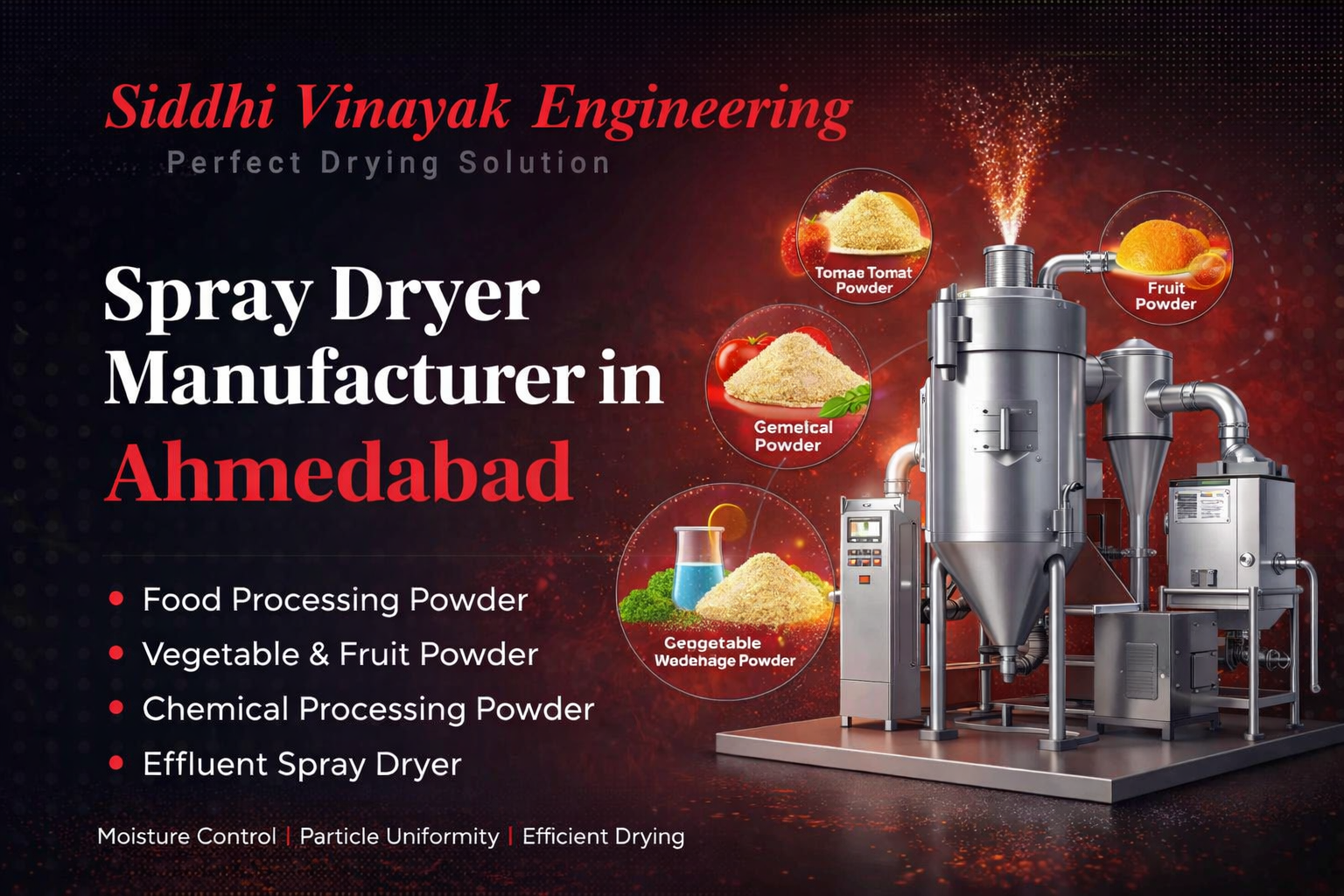
Spray Dryer Manufacturer in Ahmedabad
Spray Dryer Manufacturer
in Ahmedabad
Industrial processing industries depend on controlled drying technology to convert liquid formulations into stable powder forms. A Spray Dryer Manufacturer in Ahmedabad plays a vital role in supporting food, chemical, and process industries where accurate moisture control, particle uniformity, and thermal efficiency are essential.
Siddhi Vinayak Engineering
Siddhi Vinayak Engineering, based in Vatva GIDC, Ahmedabad, manufactures spray dryers, spin flash dryers, flash dryers, evaporators, fluid bed dryers, hot air generators, and related drying systems. Operating from an industrial facility in Gujarat, the company supplies engineered drying solutions for various industrial applications. Its product portfolio serves food processing, chemical processing, effluent treatment, and powder manufacturing sectors.
Spray drying technology enables manufacturers to transform liquid feed into consistent powder while preserving the material's functional characteristics.
Understanding Industrial Spray Drying Technology
Spray drying is a continuous process in which a liquid or semi-liquid feed is atomized into fine droplets and exposed to controlled hot air inside a drying chamber. Rapid moisture evaporation converts these droplets into dry powder particles. This method is widely adopted in industries that require consistent particle size, uniform moisture content, and stable shelf life.
In food processing applications such as tomato powder production, spray drying helps retain color, flavor, and nutritional properties while converting liquid pulp into free-flowing powder. The process operates within a controlled environment, reducing contamination risks and improving production efficiency.
Key Components of a Spray Drying System
An industrial spray dryer consists of integrated components designed to ensure efficient and stable operation:
- Atomization System – Rotary disc atomizers or pressure nozzles convert liquid feed into uniform droplets.
- Drying Chamber – A specially engineered chamber where hot air interacts with atomized droplets for rapid moisture removal.
- Air Handling Unit – Supplies controlled hot air using direct or indirect fired hot air generators.
- Powder Collection System – Cyclone separators, bag filters, or collection units separate dry powder from exhaust air.
- Control System – Regulates temperature, airflow, feed rate, and pressure for consistent process performance.
The coordination of these systems directly influences product quality and overall plant efficiency.
Applications of Industrial Spray Dryers
Spray dryers manufactured in Ahmedabad are used across multiple sectors:
- Food processing for fruit and vegetable powders
- Nutraceutical manufacturing for supplement powders
- Dairy and beverage industries for instant mixes
- Chemical processing for powdered compounds
- Effluent treatment plants for waste drying
- Agro-processing units for agricultural product powders
The flexibility of spray drying systems allows both small-scale and large-scale continuous production.
Process Flow of a Spray Drying Plant
A typical spray drying process follows a structured sequence:
- Liquid feed preparation and filtration
- Pumping of feed to the atomizer
- Atomization into fine droplets
- Contact with heated air inside the drying chamber
- Rapid moisture evaporation
- Separation and collection of powder
- Exhaust air treatment through filtration systems
Factors Affecting Spray Dryer Performance
The performance of a spray drying system depends on several operational variables. Inlet air temperature influences drying speed, while outlet temperature determines final moisture content. Feed concentration and viscosity affect droplet formation. Airflow patterns within the chamber impact residence time and drying uniformity.
Particle size control is critical for achieving the desired bulk density and solubility. Excessively high temperatures may degrade sensitive compounds, whereas insufficient heat can result in higher residual moisture. For this reason, automation and process monitoring systems are essential in industrial environments.
Spray Dryer Manufacturer in Ahmedabad for Industrial Infrastructure
Ahmedabad has emerged as a major manufacturing hub in Gujarat, supported by established industrial infrastructure, skilled technical manpower, and access to engineering supply chains. Vatva GIDC, where Siddhi Vinayak Engineering operates, is one of the region's well-developed industrial estates.
Its strategic location provides logistical advantages for serving clients across Gujarat and other states. The surrounding ecosystem of fabrication, machining, thermal engineering, and industrial automation industries supports the manufacturing of large-scale drying equipment.
Types of Spray Dryers Offered
Industrial manufacturers typically provide multiple spray dryer configurations to meet application-specific requirements:
- Rotary Disc Atomizer Type Spray Dryer
- Nozzle Type Spray Dryer
- Versatile Spray Dryer Systems
- Effluent Spray Dryer
- Hybrid Evaporator Integrated Spray Dryer
Selection depends on feed properties, required particle size, production capacity, and thermal sensitivity of the material.
Quality and Process Considerations
Maintaining product quality in spray drying requires systematic control of operating parameters. Hygienic design is particularly important in food processing applications. Stainless steel contact parts and easy-to-clean configurations support sanitary compliance.
Controlled airflow minimizes powder agglomeration and chamber sticking. Efficient powder collection systems reduce material loss and improve yield. Industrial control panels and instrumentation enable operators to monitor temperature, pressure, and flow conditions accurately.
Advantages of Spray Drying for Industrial Production
Spray drying offers several technical advantages:
- Rapid drying that limits prolonged thermal exposure
- Uniform particle formation
- Scalable production capacity
- Continuous processing capability
- Extended shelf life of perishable materials
These benefits make spray dryers a preferred solution for industrial powder manufacturing.
Choosing a Spray Dryer Manufacturer in Ahmedabad
When selecting a spray dryer manufacturer in Ahmedabad, industrial buyers generally assess engineering expertise, manufacturing infrastructure, customization capability, and technical support. Plant layout planning, energy efficiency, and post-installation service are also important considerations.
A structured manufacturing setup in an industrial estate such as Vatva GIDC enables equipment fabrication, assembly, and testing prior to dispatch. Access to technical consultation ensures that the system configuration aligns with specific process requirements.
Conclusion
Spray drying technology plays a central role in industrial powder production across food, chemical, and processing sectors. A Spray Dryer Manufacturer in Ahmedabad supports this demand by delivering engineered drying systems designed for consistent moisture control, particle uniformity, and operational stability. With integrated evaporators, hot air generators, and precision atomization systems, industrial spray dryers enable efficient and scalable production for a wide range of applications.